Quantcast
Channel: Moon In The Gutter

SYLVIA KRISTEL: FROM EMMANUELLE TO CHABROL Now Shipping

$
0
0


My book SYLVIA KRISTEL:  FROM EMMANUELLE TO CHABROL is now shipping from Cult Epics.  Folks that pledged to the campaign last year or who pre-ordered from Cult Epics are receiving their books right now.  
The general release date from all other sellers, including Amazon, is June 8th.  
It's very exciting that the book is finally out and I hope all that have received it are enjoying it.  Please consider leaving a review on Amazon, Goodreads, or any other retailer, if you are. 
Thanks so very much!


Try Another World

$
0
0


Greetings all.  Just a quick note to mention that from here on out I will be posting almost exclusively at my official site, Nostalgia Kinky.  While I probably won't be adding much here anymore, I am leaving Moon in the Gutter, which is now over fifteen years old, open for any to peruse the past contents here.  I plan on updating Nostalgia Kinky more and more and will continue adding content to my Sylvia Kristel Archives as well.  I have added a widget near the top of the blog here that will link to my recent posts at Nostalgia Kinky and I invite any interested in my work to follow me there.  I am also working more and more at my YouTube channel, Nostalgia Kinky, for any interested.  Thanks so very much. 

-Jeremy Richey-   

Jason Banker's TOAD ROAD (2012)

$
0
0
Among the most damaging and devastating American films I have seen in quite some time, Jason Banker's haunting Toad Road is one of the most original and startling works in recent memory.  An almost entirely improvised micro-budgeted production shot mostly in Pennsylvania, Toad Road is just the second feature from Banker but he is already clearly one of the most visionary young filmmakers in the country.  While the influence of figures such as Harmony Korine and Gus Van Sant can be felt throughout Toad Road's slim running time of just over 75 minutes, it is one of the most unique productions I have had the pleasure of viewing in some time.  Part horror film, part existential youth-drama, part cautionary-drug tale and finally part love story, Toad Road defies easy categorization and I haven't been able to shake it since experiencing it a number of days ago. 

"

With these opening words, spoken in an eerily hushed tone by the remarkable Sara Ann Jones, the non linear Toad Road begins and the viewer is immediately pulled into the aimless world

The Robert Kerman Fundraiser

$
0
0


An actor and man I greatly admire, Robert Kerman (aka R. Bolla) is in a very bad way and is need of our help this holiday season.  Please click on this link for information on the Robert Kerman Fundraiser.  Any, and all, donations, are greatly appreciated!

Coming 2/18/2014: A Jean Rollin Box-Set from Redemption

Coming in November of 2014: The First Issue of Our New Publication

$
0
0

While a great many friends over at Facebook are already aware of this, I am very pleased to officially announce here that my wife Kelley and I will be releasing the first issue of our first printed publication in the late part of 2014.  This, as of yet, untitled publication is still in the earliest stages of planning but Kelley and I are both extremely excited about it and we are going to make it something truly special.  This will be a step by step process and will be a true learning experience for both Kelley and I, as we have never attempted anything like this.
While the details are being ironed out I can tell you that this will be a print only arts based publication allowing writers to write on topics of choosing.  Obviously the journal will consist of a lot of writing on film but it will also incorporate literature, music, photography and so on.  This will not be a 'review-based' publication (although certainly critiques can occur), but rather a platform for all types of writers to really flex their creative muscles and have a chance to get pieces in print that otherwise they might not be able to. 
Throughout 2014 I will mostly be utilizing Moon in the Gutter as an information base on the first issues progress.  There will be other posts as well, and eventually a website will be set up for the journal, but I do want to share this journey with any who might be curious to follow.  Here is an outline of our plan:

1.  Gather together a number of our favorite writers and ask if they would be interested in submitting for the first issue.  I am very excited to say that we have gathered close to twenty fabulous writers already with more coming on board as I type this. If you are interested in possibly submitting, please contact me at Facebook or via my Gmail. I will be introducing the writers here at Moon in the Gutter in the upcoming months as well as unveiling our fabulous first cover star!

2.  Since this is a self-financed venture, Kelley and I will need some help regarding the software and a few other start-up expenses so we will be doing a Crowdfunding drive, probably via IndieGoGo.  We are planning on launching this probably around late January and rewards will be offered.  This is, obviously, a pivotal step, so any help (whether it be a donation or just spreading the word will be greatly appreciated). 

3.  As soon as we have the software in place and the pieces start coming in Kelley and I will spend the better part of 2014 putting the first issue together.  Since, as I said, this is a totally new thing for us it will take time.  Thankfully we already have a friend who is familiar with the program we are planning on using (AdobeInDesign) but we would, of course, love to hear from anyone who might have any advice, tips, or suggestions throughout the process. 

4.  PUBLISH!!!  Initially Kelley and I had planned on printing this ourselves in a limited edition run and handling the shipping.  We finally decided that the cost and time would be too much for us to handle so I am taking the lead from my good friends over at Weng's Chop and am planning on using Amazon's print on demand service CreateSpace.  This will allow the journal to be sold at Amazon and Barnes and Noble's sites, as well as our own site, and it doesn't have to be a limited run.  We are looking at the first issue as a break even proposition at best and we will try to make it as affordable as possible, while making sure that is as colorful and aesthetically pleasing as we are planning. 

So that about does it.  This has been a dream of mine since I first cracked open an issue of Video Watchdog in the early nineties and I promise we are going to deliver something very special.  Hell, with the writers I have on board we could do an old school Xerox pamphlet and it would still be awesome but we are going to give you more than that.  Wish us luck and enjoy, 'the first song on our new album.'

-Jeremy and Kelley Richey, 2014-

The Alain Robbe-Grillet Collection from Redemption

$
0
0
Here is a sneak peek at what very well might be the most important archival series of the year.


TEARS OF GOD, THE BOOK and VIDEO WATCHDOG Crowdfunding Campaign Videos

$
0
0
These three very valuable projects are in need of funding over at Kickstarter and Indiegogo. Take a few moments to watch, pledge and/or help spread the word if you can. Thanks!

Celia Rowlson-Hall to Appear on the Cover of ART DECADES (Issue 1)

$
0
0


When I decided this past October that I finally wanted to launch my first publication one thing I knew for sure was that I wanted the cover to be something incredibly special.  Even before I came up with a name for the publication, ART DECADES, I knew that my first and only choice for our first cover star was a young filmmaker whose work has meant oh so much to me the past couple of years.  So, I am incredibly excited to announce that the genius New York based actor, choreographer, director and writer Celia Rowlson-Hall will be appearing on the cover of Issue 1 of ART DECADES in a photo taken specifically for the publication.  I will be writing a long piece on Celia's remarkable work and I am beyond honored and thrilled that she agreed to appear on the cover.  I cannot possibly began to express my eternal gratitude. 
More information on ART DECADES is coming soon including a look at some of the contributors and more.  Also keep a lookout for our IndieGoGo Crowdfunding campaign which will be starting in the next week or so. 

Europe Endless: Alain Robbe-Grillet's TRANS-EUROP-EXPRESS (1967)

$
0
0
Only available for years via dreadful quality bootlegs, the classic films of the legendary Alain Robbe-Grillet are finally getting ready to land on American shores on Blu-Ray and DVD courtesy of Redemption's new The Cinema of Alain Robbe-Grillet collection.  The first two releases in the series, Trans-Europ-Express (1967) and Successive Slidings of Pleasure (1974) come out in early February and both are nothing short of spectacular.  
It is fitting that Redemption's first Robbe-Grillet release is his groundbreaking Trans-Europ-Express, a miraculous work that stands as a perfect gateway into the French renegade's most distinctive cinematic world.  Alternately playful and subversive, Trans-Europ-Express is still an astonishingly forward thinking work detailing the complex, and often surprising, relationship between an author and his characters.  Starring New-Wave icons Jean-Louis Trintignant and Marie-France Pisier as two characters being constructed right before our very eyes by Robbe-Grillet and his wife Catherine (both appearing as themselves), Trans-Europ-Express perhaps feels even more adventurous today than it did in the more openly confrontational and experimental sixties. 
Like many of Robbe-Grillet's early literary works, Trans-Europ-Express manages to avoid the pretentious pitfalls of most deliberately self-reflexive post-modern works by maintaining a sharp wit throughout.  While Trans-Europ-Express is rightfully grouped among the most serious European Art Films of the sixties it is also one of the funniest and Robbe-Grillet's delightful willingness to play with pre-conceptions of character, story and the filmmaking process is incredibly refreshing.  It's among just a handful of films that makes you questions cinema's role while enhancing your enjoyment. 
Trans-Europ-Express was just the second film Robbe-Grillet had made as a director (with the 1963's mesmerizing The Immortal standing as the first) but he already had mastered the difficult task of translating many of the questions his novels posed into answers on the screen.  As a filmmaker, Robbe-Grillet's daring framing skills and his dazzling use of space were already apparent in Trans-Europ-Express and in cinematographer Willy Kurant he found the perfect artist to help bring his black and white world of eroticism and intrigue to life, although the two wouldn't work together again. 
A lot of the credit for how successful Trans-Europ-Express is as an incredibly entertaining film, and not just an odd experiment, has to go to Robbe-Grillet's incredible stars, Trintignant and Pisier, whom both dive into this uncompromising material with an absolute gleefulness.  Many actors would have shied away from some of the satirical self-poking that these two iconic stars are asked to perform in Trans-Europ-Express so it is to their credit, and the film's benefit, that they were so game. 
Redemption's Blu-ray of Trans-Europ-Express is a thing of beauty.  Mastered in HD from the original 35mm elements Kino and Redemption's team wisely didn't overly digitize this print and the silver grain necessary for its glorious black and white photography is still in place.  It's truly lovely to finally see this film looking and sounding like this.  Extras include a thirty minute chat with the much-missed Robbe-Grillet and a trailer reel.  Sadly, the Tim Lucas commentary tracks that grace the international releases are absent but, otherwise, this is an absolutely essential release in every way.  Pre-order it at Amazon

-Jeremy Richey, 2014-

The Ms.45 Soundtrack is Now Available to Pre-Order from Death Waltz Recordings

$
0
0


Fans of Zoe Tamerlis Lund, Joe Delia and Abel Ferrara have certainly had to wait a very long time for the soundtrack release to their mesmerizing masterpiece Ms.45 but the wait I finally over.  Delia's incredible score is now available to pre-order over at Death Waltz Recordings and Light in the Attic via a limited to 500 copies Vinyl edition.  Hardcore fans will want to order directly from Death Waltz because they will get an instant free download of the score and over an hour of unused music from the film!   I am listening to it right now and to say it was worth the wait is an understatement...it is absolutely incredible. 

Dog Will Hunt: Tobe Hooper's THE TEXAS CHAINSAW MASSACRE 2

$
0
0
There is something downright heroic about Tobe Hooper’s The Texas Chainsaw Massacre 2. Almost three decades after its initial release, Hooper’s daring follow-up to one of the most iconic American Independent films ever made can now be viewed as one of the bravest, most unconventional and most confrontational works of the eighties. A wildly subversive blood-soaked black comedy that lays to waste the conservative landscape of the Reagan fueled era, The Texas Chainsaw Massacre 2 is a fully loaded work fueled by the visions of a combative and iconoclastic filmmaker, with something to prove, and an undervalued writer looking to chop away at what had become of the American dream. Tobe Hooper should have been riding high by the mid-eighties. After all he had just achieved the biggest commercial and critical success of his career just a few years earlier with 1982’s Poltergeist but that success had been undercut by widespread rumors that it was more producer Steven Spielberg’s work than Hoopers. Struggling to regain his footing Hooper delivered two high-profile failures, that have since become fan favorites, Lifeforce (1985) and Invaders from Mars (1986) before he finally decided it was time to revisit the legendary film that had put him on the map in the first place. The key to understanding The Texas Chainsaw Massacre 2 in relation to its more acclaimed predecessor is to look at the very different times in which they were made. Even though just over a decade separated Hooper’s films the cinematic and social landscape had changed dramatically between 1974 and 1986. The audiences that had flocked to the first Chainsaw were still reeling from Watergate, Vietnam and the crushing realization that the sixties were indeed over. In contrast by the mid-eighties it was commerce and consumption that was on most Americans minds and film audiences were no longer interested in supporting the paranoid fueled individualistic works of the seventies. For a nonconformist like Tobe Hooper, this must have been a most bitter pill to swallow. The man who had received worldwide acclaim just a couple of years before the premiere of The Texas Chainsaw Massacre 2, for his award winning screenplay for Wim Wenders’ mesmerizing art-house classic Paris, Texas (1984) might have seemed an odd-choice for Hooper’s misunderstood sequel, but renegade L.M. Kit Carson was the absolute perfect pick. Like Hooper, Carson hailed from Texas and, like Hooper, he had come of age in the liberal freewheeling era of the seventies. The two were actually a match made in heaven (or hell, depending on your point of view). Art-house meets the Grindhouse…and, as driven by Carson’s words and Hooper’s direction, The Texas Chainsaw Massacre 2 would indeed turn out to the kind of oddball avant-garde exploitation film that few creative minds could even hope to concoct. Of course they had to go through hell to get their peculiar vision on the screen; battling every step of the way with a company who pulled the financial rug out from their feet before the cameras had even rolled. The entire behind the scenes struggles and turmoil are documented on Arrow’s astonishing new limited edition box-set dedicated to The Texas Chainsaw Massacre 2. Like many of cinema’s great films, The Texas Chainsaw Massacre 2 is a compromised work but Hooper and his tireless crew worked through the compromises and delivered just the kind of searing and unhinged picture they promised.
The majority of sequels we see today crowding our local corporate owned megaplexes are essentially just remakes or retreads of the films that they are following. It has kind of become the norm to accept this and it is that attitude that still makes The Texas Chainsaw Massacre 2 feel so downright revolutionary. Audiences expecting the chilling coldness of the first film will be shocked by the anarchic humor on display in The Texas Chainsaw Massacre 2. It is an extremely funny film, thanks mostly to Jones multi-layered script and the demonic performances of both Dennis Hopper and especially Bill Moseley. Far from being just a ferociously funny and gory freak show though, The Texas Chainsaw Massacre 2 also works as a frenetic fright film, even though it wisely never attempts to reach the terrifying highs of its predecessor. If there is a clear thematic connection between the first Chainsaw and the second it can be found in Hooper’s decision to once again find a strong leading lady to guide the final act. Just as Marilyn Burns’ petrifying turn in the original helped give that extraordinary film the heart and soul it has the vastly underrated Caroline Williams, as the feisty D.J. Stretch, does the same for Hooper’s unexpected sequel. Williams is terrific in the film and gives a visceral, and at times oddly moving, performance that is the equal of Burns more well-known work.
The Texas Chainsaw Massacre 2 was slapped with an X rating when it his theaters in 1986 due to its violent content and generally chaotic nature. Cannon films had no idea what to do with it and both critical and fan reaction was wildly mixed. The film would quickly become a fan favorite once it hit video and by the time MGM released their own special edition DVD a decade or so ago it had become a bona-fide cult classic to many, although it has never garnered the same amount of acclaim and attention that the first film has. Arrow’s new collection is tremendous and it ports over all of the excellent material from MGM’s disc. There is new content as well including an excellent retrospective documentary featuring “Still Feelin’ the Buzz” and, best of all, a bonus disc entitled The Early Films of Tobe Hooper, which features 2 incredibly rare late sixties works from the man (The Heisters and Eggshells) with an additional commentary and a fascinating interview. It is a truly terrific collection dedicated to a very valuable film and filmmaker. The Texas Chainsaw Massacre 2 will never be granted the classic status of its more famous parent and, perhaps, that is fitting since the film was a bit like the unruly child few wanted. Hooper’s ferocious follow-up film had the misfortune (or perhaps fortune) to land in the cinematic dustbin that was American film in 1986 and many just won’t be able to separate it from a period when most of the renegade filmmakers of the seventies had either called it quits or sold out completely. Tobe Hooper would never again attempt to make something as wildly ambitious or challenging as The Texas Chainsaw Massacre 2 but, ultimately, he didn’t have to because he had already given American cinema not one but two of its most defining films. Jeremy Richey, 2014

The Destroyed Girl: Alain Robbe-Grillet's EDEN AND AFTER

$
0
0
After years of being passed thru the hands of collectors via poor quality grey-market copies, one of the seventies greatest films has finally been granted an official home video release in The United States. Alain Robbe-Grillet's fourth feature film as a director, and his first color production, "L'éden et après" (Eden and After) can now finally be enjoyed by American audiences via a striking Blu-ray from Redemption and Kino Lorber. Mastered from the original 35mm elements, Redemption's new Blu-ray is absolutely dazzling and Robbe-Grillet's astonishing and bold use of color is serviced perfectly on this important new release. Robbe-Grillet admits on the thirty minute interview that graces the disc's supplements that he didn't have a script going into production of Eden and After and, astonishingly, the brilliant lead actress Catherine Jourdan was only brought on board three days before shooting began. The late Robbe-Grillet is still clearly haunted by the memory of the mesmerizing Jourdan during the interview and credits not only the success of the film to her but also states that the final film ultimately took its shockingly symmetrical shape around her. Born in France just a couple of weeks before Halloween in 1948, Catherine Jourdan was one of the most beguiling and puzzling performers who came out of the French New Wave. The great Jean-Pierre Melville was the first filmmaker to capture her haunting and unforgettable face in his 1967 masterpiece Le Samourai but appearing in such an auspicious debut did little to forward her career. Jourdan appeared in a few features throughout the late sixties but her film career was all but stagnate by the time she received a call from Alain Robbe-Grillet (who recalled a night dancing with her at a Parisian nightclub a year or so before) to appear in the new color production he was mounting. It is impossible to discuss Eden and After without focusing on the tour de force performance by the elusive Catherine Jourdan. She controls nearly every frame of the film and Robbe-Grillet's camera is clearly in love with her. Watching her performance today it is both baffling and troubling that she didn't have greater success after its release. While she appeared in a number of productions after Eden and After before her death in 2011, Jourdan was never again granted to the kind of role Robbe-Grillet granted her.
 Eden and After is the most 'painterly' film in Robbe-Grillet's iconic body of work. He admitted as much to Anthony Fragola in The Erotic Dream Machine by stating that, "there exist many references to painting in Eden and After-in particular a live reproduction of a famous painting by Marcel Duchamp, Nude Descending a Staircase, No 2." Duchamp, doppelgangers and an unnerving mathematical sense of structure guide Eden and After. Inspired by the twelve-tone music of Schoenberg, Robbe-Grillet used a chart her created of, "twelve recognizable themes", instead of any kind of traditional script to create Eden and After. As in all of his films Robbe-Grillet delights in destroying any sense of traditional narrative structure in Eden and After and it stands as one of the most authentically dreamy and hallucinatory films ever made...the viewer slips down the druggy rabbit hole with Jourdan and you will either want to escape or never emerge again.
 A lot of credit for Eden and After's success has to go to cinematographer Igor Luther, the great Czech artist who had previously worked with Robbe-Grillet on The Man Who Lies. Luther's use of color in Eden and After is never less than jaw dropping and the color red has never been quite as seductive and sinister as it is here. Robbe-Grillet told Fragola that he loved Red because it, "is the color of blood", and, "all my films shot in color involve blood...so it is the color red that interests me."
 Eden and After, and its companion film N Took the Dice (also included on Redemption's new disc) stand as bold reminders to cinema's great visual power. Watching the film on this new disc reminded me of just how depressingly unimaginative most modern films are. Robbe-Grillet's films are a gob in the face to anyone who questions films place as great art. Pretentious? Absolutely and in the best possible way.
Redemption's new Blu-ray is light on extras and is missing the Tim Lucas commentary track and Catherine Robbe-Grillet found on the British release but having the stunning HD print alone is well worth the price of the disc. Eden and After stands as not only one of the great modern films but perhaps the most stunning example of Robbe-Grillet's unbelievably distinctive cinematic vision. It also stands as a great tribute to a young woman who should have had a more successful career as an actress. As Robbe-Grillet stated in The Erotic Dream Machine, Eden and After is ultimately the "story" of Catherine Jourdan, and what a endearing and profound tale that turned out to be.


 -Jeremy Richey, 2014-

"This One Goes to Eleven!" Mike 'McBeardo' McPadden's HEAVY METAL MOVIES

$
0
0
An incredibly entertaining, and compulsively readable, book from journalist and former Hustler editor Mike "McBeardo" McPadden, Heavy Metal Movies is the newest epic tome from the great folks over at Bazillion Points and it is another knock out of the park. Coming in at well over 500 pages, this massive tribute to the sometimes surprising connections between films and heavy metal comes with the fitting tagline, "Guitar Barbarians, Mutant Bimbos & Cult Zombies Amok in the 666 Most Ear-And Eye-Ripping Big-Scream Films Ever!"  and it more than lives up to that ambitious promise. Brooklyn born McPadden worked for years researching and writing Heavy Metal Movies and the effort paid off as this is one of the most entertaining and exhaustive books on film in recent memory. Far from an overtly serious or critical guide, Heavy Metal Movies is a wonderfully humorous and witty work that is as engaging as many of the wild cult and exploitation films it covers. While McPadden's style is breezy and personal, make no mistake this is a guy who knows his stuff and many of the connections he makes in Heavy Metal Movies are both eye-opening and unexpected. Featuring hundreds of black white images, with a very striking color section, the layout of Heavy Metal Movies is a simple, but effective, A to Z listing of the 666 films that in some way or another have a connection to Heavy Metal music. The connections range from the very subtle to extremely strong and while some of McPadden's choices might seem odd his reasoning is almost always sound. While the tales of musicians who have been influenced by specific films are fascinating what I really like about the book is McPadden's way of making the reader perhaps look at a film they thought they knew as well as possible in a slightly different way. That said, the one flaw the book has is that it is at times a bit too far reaching on certain titles (should something like Jawbreaker be included just because "Rock Me Like a Hurricane" is featured) but that's a very small complaint as this is a very pleasing book that a lot of obvious love and work was put into. Heavy Metal Movies also includes a lively introduction by McPadden, Alice Cooper discussing his favorite 'Metal' film and some audacious lists focusing on things like the most Metal moments in movie history. Order it directly from Bazillion Points and get a limited color sewn patch (that you can slap on your cut off jean jacket next to your Iron Maiden and Angel Witch logos). Copies can also be obtained from Amazon and other online retailers.

-Jeremy Richey, 2014-

DistribPix unleash the long awaited William Lustig 'Billy Bagg' Special Edition!!!

$
0
0

Before he electrified audiences with his legendary Maniac, filmmaker William Lustig shot two underground New York classics under the name Billy Bagg, The Violation of Claudia and
Hot Honey.  These long hard to see features, starring the likes of Sharon Mitchell, Jamie Gillis, Long Jeanne Silver and Serena, have been finally restored by the great folks at Distribpix and they are getting ready to come out on DVD via a brand new special edition set.  Special features include trailers, slideshows and best of all new audio commentaries with Lustig and Drive director Nicolas Winding Refn!  This collection promises to be one of the essential releases of the year.  More info can be found here

The Complete Henry Paris

$
0
0


When it comes to the films of Radley Metzger, I have always worn my heart on my sleeve.  I adore the man, I love his films...I love everything about them and think that they are among the finest and most important post-war works from any American filmmaker. 

A Look At Jean Rollin's THE ESCAPEES on Blu-ray

$
0
0
When Redemption released Jean Rollin's Les Paumees Du Petit Matin (The Escapees) back in 2009 on DVD the disc felt a bit like of a Godsend for fans. After all, The Escapees had long been one of the hardest of Rollin's features to see, so finally having an official release was in itself a cause to celebrate. Sadly that 2009 DVD was mired by a number of technical issues. The non-anamorphic disc offered up a flat smeary looking print with drab colors and a generally inconsistent look. Add on to the visual problems present, Redemption's original DVD offered up the soundtrack in a muffled and static mix that did the film no favors. In other words, despite how welcome it was for Rollin's fans, the original DVD for The Escapees was a bit of a mess.
Flash forward nearly six years later and Redemption (partnered with Kino Lorber) has re-released The Escapees on Blu-ray in a terrific new HD print remastered from the original 35 mm negative that trumps that original DVD in every way. Finally we can see one of Rollin's most distinctive and unique films the way it was intended and the results are, at times, startling.
Few filmmakers used colors the way Jean Rollin did, and now with this new HD print we can see that this fact carried through with The Escapees. Whereas Redemption's original DVD had a flat and greyish look about it, with this new disc the colors really pop the way we know that Rollin intended. The improvement is apparent from the get-go (look at the way the dewy green grass present in the opening moments draws the viewer in immediately) and the disc's color palette stays wonderfully consistent throughout. The film's haunting and marvelous ice-skating sequence feels especially alive and vibrant now on this new disc. While I still have issues with the film and don't consider it among Rollin's finest works, I enjoyed it much more via Redemption's new Blu-ray than I ever have before. Back in 2009 I wrote that it is, "Stylistically as far away from his early dazzling Jean-Jacques Renon lighted works as possible, The Escapees is a cold and somber film" and, while I still agree partially with that, this new release shows that The Escapees is a much more electrifying and vibrant work than I had previously realized. There are still major problems with the film's final act, that not even this sharp print can help, but it isn't the "disaster" that Rollin once called it all. He was much more on point when he noted in Virgins and Vampires that “certain scenes emerged” amidst the flaws as there is an undeniably hypnotic and haunting quality about the film that is unique to Rollin’s work.
The problem's with the films soundtrack have no also been corrected in this new HD version and this greatly benefits the fine if spare piano based score from frequent Rollin composer Philippe D’Aram. The Escapees remains a frustratingly inconsistent picture but it has moments of greatness. As Cathal Tohill and Pete Tombs noted in their wonderful Immoral Tales, "what is good in (The Escapees) is very good."
This exciting new Blu-ray of The Escapees (which thankfully ports over the wonderful "One Day In Paris: An Interview With Jean Rollin" from the older DVD) can be ordered at Amazon. More information can also be found here.

-Jeremy Richey, 2015-

A Final Audience With Lilli Carati and A Look At Reel Gore's First Release VIOLENT SHIT

$
0
0

When Lilli Carati tragically passed away, after a long battle with Brain cancer, just before Halloween in 2014 the Italian genre cinema lost one of its most fascinating and mysterious stars. Born Ileana Caravati in Lombardy, Italy in 1956, Carati grew up loving the arts, film and music and began working as a model as a teenager. Before she was even twenty, Carati was appearing in a number of Italy's most popular magazines and in 1975 she was nearly crowned Miss Italy. 1975 is also the year that she would first begin her soon to be blossoming acting career with a brief appearance in Sergio Corbucci's anthology film Di che segno sei?. Carati quickly became an in demand figure in the Italian film industry and throughout the mid to late seventies she appeared in a slew of pictures ranging from Italian Sex Comedies to Police Action works. Carati was beautiful and vivacious and by 1978 was even beginning to attract some filmmakers in the art house world such as Lina Wertmüller, who cast her in a small role in her 1978 production A Night Full of Rain. It was a different 1978 production that Carati would most be remembered for though in a film as far removed from Wertmüller's world as imaginable.

Fernando Di Leo's To Be Twenty remains one of the most disturbing and shocking films of the seventies, mostly due to a vicious ending that will leave even the most jaded genre film fan reeling. Carati, along with her co-star Gloria Guida, gives an unforgettable performance and the film remains the high water mark of her career. To Be Twenty is a troubling work but Carati really shines in the film with a performance that is funny, provocative and very sexy. Following Di Leo's controversial work Carati would continue working throughout the eighties but personal problems coincided with a dying Italian film industry and by the end of the decade Carati found herself broke, depressed and desperate...three factors that led her into hardcore work that she clearly didn't want to be doing. Disillusioned by the film industry she had once so much loved, a heartbroken Carati all but retired in the early nineties and disappeared from the public spotlight nearly for good.

According to the liner notes of the inaugural Blu-ray/DVD set from Reel Gore Releasing Violent Shit, Italian filmmaker Luigi Pastore tracked Carati down in 2012 and "attempted to revive her career" with a role specifically written for her in his Dorian's Dark Fairytale. Sadly, Carati became very ill around that time the first footage was shot and "Pastore was unable to complete the film without her." Thankfully, as a tribute to her memory, Pastore decided to use the footage in his newest film, Violent Shit, and Carati's final moments on celluloid can now be viewed on Reel Gore's extravagant first release. Fans, like myself, can also watch the final moving interview that the still glowing Carati gave before she became sick, on the set's exhaustive special features, where she is clearly excited and happy to be returning to film. The interview is a poignant viewing experience and is a highlight of Reel Gore's first release.

As a film, Violent Shit is a bit all over the place. An updating of the notorious no budget German shocker, Pastore's film is meant as a tribute to the great Italian Giallo productions of the seventies and eighties and is filled with as many references and cameos as it can pack into its under 90 minute running time. Fans of the genre will no doubt have a blast trying to catch all of the references, which range from the obvious to the sly, but the film doesn't really go anywhere until its final half hour when it finally does live up to its title with a series of vicious killings that will prove very pleasing to both gore hounds and special effects enthusiasts. David Bracci's old-school practical effects are the major pleasure the film offers along with the very pleasing, if plundering, Claudio Simonetti soundtrack, which is thankfully included as a CD Bonus.


While the film is only marginally succesful, Reel Gore's delivery of it is out of this world. Arriving as a 3 disc set, with a lavish full color booklet, Reel Gore have announced themselves as a major new player on the home video scene with this release. Containing interviews, documentaries, trailers, a collectable card and the aforementioned soundtrack, Reel Gore's release of Violent Shit is among the most noteworthy of the summer. Issues with the film aside, all of the supplements are fascinating to watch and the Simonetti soundtrack is a strong and vibrant listen. Cult Epics founder Nico B and film producer Steve Aquilina’s new horror label is one to watch and their second packed release, Masks, is just around the corner.
More information on Reel Gore can be found at their official site, Facebook, Twitter and YouTube.

-Jeremy Richey, 2016-

Remembering Radley Metzger: The Henry Paris Years

$
0
0
This past weekend we lost one of of our great cinematic visionaries.  Radley Metzger wasn't just a great filmmaker.  He was one of THE GREAT filmmakers.  A writer and director who changed the course of cinema history, Metzger was one of our great American artists and while I'm saddened that he has passed I am happy that he was able to witness so many of his greatest films treated with the respect they deserved, in the past decade, by companies like Arrow, Cult Epics and Distribpix. Despite the fact that Metzger was without question one of the most influential directors in film history, many mainstream critics have still yet to give him his justified due.  I was deeply troubled this past week by a number of articles that attempted to play down both his absolute genius and especially what is arguably his most important period, the Henry Paris years where he made some of his absolute finest films while working in the hard core genre.  As a tribute to one of my great heroes, I have decided to dust off my own looks at Merzger's key 'Henry Paris' signed films and present them in a new post here.  This post marks my return to blogging after quite a long hiatus and includes my new thoughts on what is perhaps, for better or worse, Metzger's most influential film Barbara Broadcast.  For more valuable information on Metzger, please visit my friends at The Rialto Report as they have recently posted a number of incredible tributes.  I offer my best wishes to Radley's friends and family during this difficult time and I offer a sincere thank you to one of the few filmmakers who managed to change the way I view and experience my greatest life obsession. Radley Metzger was an absolute giant and his passing leaves the greatest of voids.  He will be eternally missed and celebrated.

THE PRIVATE AFTERNOONS OF PAMELA MANN (1974)


Easily one of the most important archival releases of the decade, Distribpix's collection dedicated to Radley Metzger's The Private Afternoons of Pamela Mann is a powerhouse release and essential purchase for Metzger-fans and cinema-lovers. This double-disc edition of Metzger's first outing as the legendary Henry Paris offers up the film completely uncut and beautifully remastered. Armed with an arsenal of valuable extras, this version of The Private Afternoons of Pamela Mann is not only the best edition of this film ever released but one of the best releases of its kind ever.


Frank is a private detective, and self-confessed peeping tom, who is hired on by a Mr. Mann to spy on his wife Pamela, as he suspects she is having an affair. Frank follows and films Pamela as she makes her way through various Manhattan locations and soon finds himself involved in a life much more complicated and surprising than he would have ever imagined.


Despite being shot on an extremely low-budget in less than a week, The Private Afternoons of Pamela Mann contains the same sort of depth, polish and style as Radley Metzger's more well-known films from the sixties and seventies such Therese and Isabelle, The Lickerish Quartet and Camille 2000. A wonderfully self-aware work powered by a smart script, witty dialogue, terrific performances and Metzger's considerable skill behind the camera, The Private Afternoons of Pamela Mann takes all the conventions of a typical adult-film and playfully turns them inside out. As Lawrence Cohen notes in his wonderful analysis in Distribix's near fifty page liner-notes, The Private Afternoons of Pamela Mann is a, "legitimate work of art", and, "one that deserves the loving attention of film connoisseurs." Radley Metzger's first Henry Paris film waves a defiant middle-finger to film fans and historians who insist on ignoring the golden age of adult cinema as a viable art-form, and it is an ideal entryway for newcomers interested in 'The Other Hollywood'.


Film historian Benson Hurst points out in his excellent notes for Distribix's booklet that The Private Afternoons of Pamela Mann came about due to a few different factors, with two of the most notable being the financial failure of Metzger's previous film, the excellent Score, and the release of Damiano's Deep Throat in 1972. Hurst notes that, "overnight the landscape for soft-core films changed", and that, "the market for stylish fantasy trips made with intelligence and high production values", like the films Metzger had been making for more than a decade, were gone. Audiences were enjoying the new-found freedom to watch more explicit forms of film-making and, though he was hesitant to join in, Radley Metzger took the plunge with The Private Afternoons of Pamela Mann and for five years he delivered the most exquisite and smartest adult films American audiences had seen before or since.


The one aspect about Radley Metzger I have always valued the most is just how much this man loves film. The near fetishistic obsession with celluloid is apparent in all of Metzger's best films and this is especially true of The Private Afternoons of Pamela Mann. Hurst writes that it just took a few minutes of meeting Metzger before the conversation turned to film and he noted that, "Radley balances an encyclopedic knowledge with a humble and genuine interest in other people's opinions." Radley Metzger, now in his seventies, remains a man fascinated by all things cinematic and this obsession is reflected in many of his most memorable characters, several of which can be found in The Private Afternoons of Pamela Mann.


It might be a surprise to those who just know his reputation as an erotic auteur, but the two most repeated images in The Private Afternoons of Pamela Mann don't concern sex. Going along with Radley Metzger's love for cinema, the two things we see the most of throughout the film are a camera and projector. Like in his earlier masterwork The Lickerish Quartet, the characters in The Private Afternoons of Pamela Mann spend much of the running time watching and studying film, and we, as an audience, are treated to numerous shots of the camera, the inner-workings of the projector and even the film itself. Metzger's first Paris production is a strikingly post-modern work that is so confident in its self-awareness that it doesn't miss an opportunity to comment on it. Make no mistake though, while it certainly has elements of satire in it, this isn't a parody of an adult-film. It is in actuality an embrace of the genre and what it is capable of. It is also a slap in the face to the conservative groups looking to ban these films and prosecute those involved with the film's most biting moment being a line delivered by Metzger's editor Lola Lagarce, who shows up as a poll-taker throughout the film asking Pamela about heated issues of the day. I won't give away the film's most explosive and funniest moment but I will say that it is perhaps the most jaw-dropping line in all of Metzger's filmography.


It is fitting that such a high quality film as The Private Afternoons of Pamela Mann be graced with an extraordinary cast and it certainly is. As the title character striking looking Barbara Bourbon is quite wonderful. Sexy, warm and witty, Bourbon really shines as Pamala Mann and its a shame she only appeared in a handful of films before retiring. Distribpix's booklet features an enlightening new interview with her that will be of great interest to those who ever wondered what happened to one of adult-cinema's greatest disappearing acts. The rest of the cast is made up of some of New York's finest including the uber-talented Eric Edwards and Jamie Gillis (whose sporting a head of hair here that I would kill for) and the iconic Georgina Spelvin, who delivers a very funny and inventive performance as Pamela's friend Linda (her Rhoda to Bourbon's Mary if you will). Also on hand in smaller roles are Sonny Landham, Darby Lloyd Rains, Marc Stevens (excluding a goofy charm), Alan Marlow, Levi Richards and gorgeous Naomi Jason (billed as Day Jason). Naomi, who would appear in the terrific The Passions of Carol in 1976, is a real scene-stealer here as a receptionist dealing with a very particular form of office-harassment.


Shot on 16mm, by furure Oscar winner Paul Glickman (as Marcel Hall), The Private Afternoons of Pamela Mann, like so many other of these films made during this period, offers up a wonderful view of New York City in the mid-seventies. With its numerous street-shots, The Private Afternoons of Pamela Mann acts as much of a valentine to the city as say a Woody Allen film from the period. For folks, like myself, who have fond memories of the city Metzger's film will be a real eye-opening experience as New York is presented so lovingly and so incredibly well.


While the release of the uncut version of The Private Afternoons of Pamela Mann would make Distribpix's collection a must-buy the Criterion style treatment the film has received as far as extras go make it truly indispensable. Disc-one offers up a fascinating commentary track from Metzger himself, as well as the original theatrical trailer, a stills gallery and an excellent near 40 minute interview with Eric Edwards. The exhaustive extras continue on disc 2 in the shape of a truly special near 40 minute chat with Georgina Spelvin (such a charmer), a 2011 re-release trailer, outtakes, stills, press-clippings, a then and now look at the locations and a never before seen alternate version of the film prepared for, but not released in, 1976. Add on the impressive almost fifty page booklet and a glossy still of Bourbon and you have one of the most comprehensive and worth-while DVD collections ever released.


More information on The Private Afternoons of Pamela Mann can be found at Distribpix's official site, order-site (NSFW) and blog. It is one of the essential collections in recent memory and Distrippix's dedication to a film most would be content to ignore is both noble and noteworthy.


NAKED CAME THE STRANGER (1975)


...

For a brief period in 1969, a Long Island housewife named Penelope Ashe was one of the most popular novelists in America. Her face was everywhere and her first book, Naked Came the Stranger, was a smash and eventually landed on The New York Times bestseller list. While there was nothing strange about a first-time writer having a hit out of the gate, the thing that made Mrs. Penelope Ashe unique was that she was as fictional as the book her name had graced. Penelope Ashe and Naked Came the Stranger were an elaborate, and quite brilliant, literary hoax put-on by a frustrated Newsday columnist named Mike McGrady, and a number of his colleagues, who set out to prove that by 1969 it was trash that was selling and not great literature. To make an odd story even odder, when the truth was revealed about Penelope Ashe, Naked Came the Stranger became an even bigger phenomenon spawning copycat books and even sequels of sorts by McGrady himself, all of which is detailed extraordinarily well by Benson Hurst in his great liner-notes to the special edition of the 1975 film based on the literary prank.


While the novel of Naked Came the Stranger was deliberate trash, the cinematic version written and directed by Radley Metzger (under his Henry Paris guise) was great-art and Distribpix's tremendous special-edition of the film finally grants its proper-placing as one of the defining films of the mid-seventies. Erotic, funny, and very smart, Radley Metzger's Naked Came the Stranger is among his greatest and most provocative works and one of the best adult-films ever made.


Radley Metzger mentions on the terrific audio-commentary for Naked Came the Stranger that by 1975 he felt, in a way, that he could do no wrong and that thought is more than accurate as he had been creatively on fire throughout the early and mid-seventies. Within just five-years Metzger had unleashed a series of erotic masterworks including The Lickerish Quartet (1970), Little Mother (1973), Score (1974), The Private Afternoons of Pamela Mann (1974) The Image (1975) and Naked Came the Stranger. This unbelievable winning-streak would crescendo in 1976 with the dazzling The Opening of Misty Beethoven, a work rightly considered as the best adult-film ever made.


While many are content writing a film like Naked Came the Stranger out of film history books, the film is a truly exceptional and special work. Lawrence Cohen writes in his wonderfully crafted analysis of the film, featured in the Distribpix liner notes, that, "if one simply dismisses Naked Came the Stranger as just another hard-core offering from the mid-seventies that is not worthy of critical attention, one utterly fails to do justice to the film's undeniable sophistication and polish." Cohen (who summons up the ghosts of Diogenes, Fitzgerald and Valentino in his notes) later writes, that Naked Came the Stranger is, "vintage Metzger" and I think it is just as good, if not better, than his first superlative effort as Henry Paris, The Private Afternoons as Pamela Mann.


While The Private Afternoons of Pamela Mann seemed obsessed with the idea of vision, then it is sound (and during one sequence the lack of) that is at the forefront of Naked Came the Stranger. From the talk radio-show that stars Darby Lloyd Rains and Levi Richards host in the film, to the incredibly humorous and sexy sequence featuring Darby listening at the door as Levi has a romantic encounter with Mary Stuart, to the astonishing silent-film section, Naked Came the Stranger is a film pushed by the importance of sound in cinema and the way that characters listen (but often don't hear) one another. Like all of Metzger's great works, it is a film fueled by his enduring love for cinema and the fact that it embraces old Hollywood in the midst of a cultural revolution that all but ended the classic-period makes it a quite profound and moving work. With Naked Came the Stranger, Metzger is indeed paying a sweet-farewell to the old while totally embracing the new.


Like all of his other Henry Paris productions, Metzger was blessed with an extraordinary cast for Naked Came the Stranger. As the frustrated housewife Gilly, who attempts to get her philandering husband's attention by having her own string of affairs, Darby Lloyd Rains is an absolute revelation and her work here is quite astonishing, as she mixes humor, grace and sexiness to absolutely devastating effect. Hurst's notes on Rains fascinating, and often frustrating, career are particularly poignant and he writes that today, "Darby lives quietly" and "remembers Radley well." Extremely handsome Levi Richards is on hand as Gilly's husband Billy and the charming Mary Stuart makes a big-splash as Billy's assistant and mistress Phyllis. Keep a look out for a hilarious cameo by iconic Marc Stevens during a party-sequence as well.


Hurst, Cohen and Ian Culmell do such an exhaustive job discussing the film in Distribpix's notes that it feels a bit awkward to go over much of it here. A few facts are worth repeating though. Metzger shot the film, just before Christmas in 1974, less than six months after The Private Afternoons of Pamela Mann had its premiere. Once again Metzger would use New York as an additional character for the film and the many shots of the city remain some of the most arresting and captivating ever captured on film. Upon release Naked Came the Stranger would be a hit with both mainstream and adult critics as well as audiences, who flocked to the film. A particularly telling portion of the disc's 'ephemera gallery' is a vintage article stating that Naked Came the Stranger was the highest grossing film in New York for a stretch in 1975, ahead of such films as Monty Python and the Holy Grail, The Day of the Locust and The French Connection 2! It's a jarring reminder as to just how disturbingly conservative film goers and theater-owners have become since the artistic golden-age of the seventies.


While Naked Came the Stranger is a wonderful film throughout its running-time it is at its most extraordinary and daring when Metzger brilliantly recreate a classic black and white silent-film at the Hotel St. George. The scene is visually jaw-dropping, beautifully-shot and stands as one of the great tour-de-force moments of Metzger's career. Watching it, in the lovely transfer from Distribpix, I teared up several times due to the fact that you would hard-pressed to find such ingenuity, passion and skill in too many American films after the seventies.


Like their exemplary releases of Metzger's The Private Afternoons of Pamela Mann and Maraschino Cherry, Naked Came the Strange has been beautifully restored from the original negative and comes armed with a slew of valuable extra-features. These include the aforementioned booklet and audio-commentary as well as deleted and alternate scenes, a look at the film's locations (then and now), trailers, radio-spots and a film-facts subtitle track. It's another beautiful and lovingly put-together package from Distribpix that again solidifies their place as some of the best film-archivists on the planet.


THE OPENING OF MISTY BEETHOVEN (1976)


What a magnificent run it had been.  Between 1966 and 1976, New York born filmmaker Radley Metzger had delivered a series of stunning films that showed him as one of the bravest, most innovative and most vital directors on the planet.  Whether his camera was capturing the streets of New York or a European countryside, Radley Metzger proved himself as one of American Cinema’s true greats, even though his deserved place in the Golden cinematic canon has still not been granted by many film historians who have continued to either ignore his landmark work or degrade it.  


While an argument can be made as to whether The Opening of Misty Beethoven is Radley Metzger’s greatest film, it is hard to deny that this 1976 masterpiece isn't his most representative.  With The Opening of Misty Beethoven, Metzger managed to capture and combine the sensual decadence of his European lensed work of the late sixties with the witty hard eroticism of his New York based pictures of the seventies.  The Opening of Misty Beethoven is the ultimate Radley Metzger film and one of the most important, and finest, English-language films of the seventies.  


While The Opening of Misty Beethoven is rightly often granted the title of the greatest adult film ever made it is also one of the warmest and wittiest.  Metzger’s modern update of George Bernard Shaw’s Pygmalion has the exhilarating flair of a classic Lubitsch film and the cinematic bravado of a vintage Hawks.  Metzger’s razor-sharp script is packed with the kind of memorable dialogue that would have made any of the great classic American screenwriters he so admires blush with envy.  The globe-trotting The Opening of Misty Beethoven (Metzger took the production to Paris, Rome and New York) is also stylistically one of the most thrilling films of the period and Metzger’s compositional strengths teamed with Oscar winner Paul Glickman’s photography will be eye opening to even the most jaded film buff. 


The Opening of Misty Beethoven was unleashed on DVD and Blu-Ray collection by Distribpix that rivals anything Criterion has ever mounted.  Treating the film as the great work of art, and bold cinematic achievement, that it is the folks at Distribpix (led by the great Steven Morowitz) have released the best archival disc of the decade and the most important, as no other film offers up the much needed rewrite of accepted film history like The Opening of Misty Beethoven.  Distribpix’s collection offers up a sparkling and lovingly restored new remaster of Metzger’s uncut opus with hours upon hours of supplemental features including documentaries, interviews, vintage materials, outtakes, deleted scenes, audio-commentaries and, best of all, the long-rumored ‘alternate’ cut of Misty.  Lawrence Cohen writes in his beautiful liner notes, in the massive fifty-plus page book that accompanies the DVD, that watching The Opening of Misty Beethoven will make film lovers rub, “ones eyes in disbelief that a such a creation actually exists” and that pretty much sums up the feeling I get when I hold the package Distribpix produced for us. 


Metzger admits in the enlightening audio-commentary that accompanies The Opening of Misty Beethoven that after the success of his first two “Henry Paris” productions The Private Afternoons of Pamela Mannand Naked Came the Stranger that he felt like he could do anything he wanted with his newest venture and that confidence is on display throughout the film.  The Opening of Misty Beethoven is the work of a master with the knowledge that he was at his peak of his powers as an artist and a filmmaker.  Film historian Benson Hurst writes in Distribpix’s booklet that The Opening of Misty Beethoven, “premiered in 1976 boasting a script, cinematography, music and acting of a caliber never seen before or since in the (adult) industry”.  This was Radley Metzger’s Magnum-Opus and I think, perhaps, the great director realized that very fact when he was making the film in the mid-seventies.  


While all of Metzger’s films are wonderful examples of true ‘director-driven’ works they all benefit greatly from Radley’s uncanny eye for casting.  The Opening of Misty Beethoven is populated by perhaps the greatest cast he ever assembled from the star making supporting turns of Gloria Leonard to Jacqueline Beudant to Ras Kean to Mary Stewart to Jenny Baxter to Terri Hall (seriously swoon) to the jaw dropping legendary lead performances by Jamie Gillis and Constance Money…every scene is just filled with some of the most beautiful, charismatic and talented performers of the period and to say they all serve the intelligence, and timing, of Metzger’s script incredibly well would be a gross understatement.  


The spirit of the late Jamie Gillis haunts every frame of The Opening of Misty Beethoven.  His award-winning turn as Dr. Seymore Love is one of the great, great creations of the seventies and stands with any ‘mainstream’ performance from 1976 you care to mention.  Gillis’ delightful work in the film is given a further heart wrenching dimension after one reads Hurst’s lovely notes about how much the film meant to the great man, which is summed up so wonderfully succiently with, “Happy times.  Happy Place.”  Hurst’s later recollection of helping put touch Jamie in touch again with his greatest leading lady Constance Money shortly before his death due to cancer in 2010 is unbelievably moving and I doubt any lover of the film, and this period, will get through this story without shedding at least a few tears.  


And what of the elusive and mysterious Susan Jensen a.k.a. Constance Money, the alluring and intoxicating disappearing-act who brought Misty Beethoven to glorious life more than thirty-five years ago?  While Distribix couldn't convince her to appear in the supplements that are on their Misty Beethoven collection, they did track her down and the documentary (and notes) on her are eye opening (I especially love when Metzger helps warmly set the record straight about her in the commentary) and the fact that she is penning a memoir is amazing news.  While she appeared in a few films after The Opening of Misty Beethoven, Money remains frozen in time due to her iconic work as Metzger’s most memorable heroine.  There is no need to say the film wouldn't have worked without Constance Money…she‘s like a collective cinematic dream as Misty Beethoven and every moment she had in front of Metzger’s camera is, for the lack of a better word, magical.


Fueled by a tremendous ad-campaign, a grand-opening night and an audacious soundtrack (compiled by the great music director George Craig), The Opening of Misty Beethoven opened in 1976 and damn near became the crossover smash Metzger had hoped for and deserved but, at the end of the day, America (and mainstream cinema) was (and is) just too uptight to truly accept the film and it remains one of the great ‘hidden’ movies in film history, although Distribpix’s jaw-dropping collection has already started opening some eyes and changing some minds.  Time rewards great works and the time for The Opening of Misty Beethoven is NOW and Radley Metzger’s acceptance into the established cinematic canon is long OVERDUE.  


Benson Hurst writes that The Opening of Misty Beethoven left Radley Metzger absolutely exhausted and that, “the grueling months in the editing room (really) took their toll".  While he managed to direct a few more films, including the final two Henry Paris films Barbara Broadcast and Maraschino Cherry, Metzger would never again be able to make a film quite as powerful and visionary as The Opening of Misty Beethoven.  With the film, he had reached the top of the mountain, took a moment to survey his great creation and then took the inevitable journey back down.  


Distribpix went to heroic lengths in restoring The Opening of Misty Beethoven and getting it, not only on a DVD set, but also Blu-ray.  While all of the extras they assembled are indeed godsends finally getting to see the alternate cut of the film (which includes a number of takes and even scenes not in the original) is particularly breathtaking.  The collection is exhaustive, lovingly assembled and it makes previous releases of the film seem absolutely quaint (although the VCA disc is worth holding onto for a commentary track with Gloria Leonard and Jamie Gillis that isn't included on the Distribpix release).  The DVD and Blu-ray set isn't the only prize available for fans of the the film as there is finally now a soundtrack (which features an astounding forty page booklet detailing Ian Culmell’s astonishing archival dedication and digging), t-shirts, posters and more.  The lucky patrons who were able to give larger amounts to the ambitious drive to get the film on Blu-Ray were even treated to additional discs of outtakes (which I oh so hope to get to see someday).  The whole package (and the passion that went into making it) is quite awe-inspiring.  


Recently Sight and Sound conducted their once every decade poll regarding the Greatest Films ever made and the results were as dull and stagnate as ever. The history of film is being turned into a tenured aging professor, at another gala honoring his past works, ignoring the students who carried on his great ideas long after he has stopped caring.  Ignore the canon, seek out the cinematic fringe dwellers and create your own greatest films list...in the words of the great Hyman Mandel, "never let the fact that they are doing it wrong stop you from doing it right."


BARBARA BROADCAST (1977)


There was no real way to follow up a work quite as towering as The Opening of Misty Beethoven.  Metzger's 1976 masterpiece closed out a stunning ten year period that few of even the greatest filmmakers could even dream of matching.  Metzger's final few years behind the camera would yield more great work but he would never top The Opening of Misty Beethoven and to Metzger's credit he knew better than to try.  Ironically, despite the fact that it doesn't stand among his greatest works, Barbara Broadcast is perhaps the most influential film Metzger ever shot especially in the realm of adult cinema as its almost gonzo like episodic nature and emphasis on stars rather than story remains the most copied hard core trope in history.  With Barbara Broadcast, Metzger took a huge creative step backwards while virtually inventing the modern hardcore film.


Barbara Broadcast is controlled by its extraordinary cast.  While bits of Metzger's trademark humor are on display, and his expertise behind the camera never falters, Barbara Broadcast is essentially a showcase for Annette Haven, Susan McBain, Jamie Gillis, Wade Nichols, Constance Money and especially C.J. Laing.  It's the work of a master but an exhausted master and it feels more like an vibrant postscript more than a completely realized great work.  


The famous tagline of Barbara Broadcast is "An Erotic Film in Four Courses" and that sums it up very nicely.  Gone is the audacious ambition of Metzger's masterworks that led up to it.  Barbara Broadcast is a deliberately bare-bones work that manages to be among the most erotic films Metzger ever made while being among the least transcendent.  Benson Hurst notes in excellent liner notes to Distribpix's incredible Blu-ray release of Barbara Broadcast that in many ways the film was, "a reaction against" the "particularly lengthy, arduous and complicated" production that had been The Opening of Misty Beethoven.  There is a sense of fatigue that controls Metzger's direction of Barbara Broadcast that isn't found anywhere else in his filmography but his perfect cast makes up for it, especially in the film's most legendary sequence featuring the smoldering pairing of Nichols and Laing, which Distribpix restored to its uncut presentation after years of being censored on past video releases.   As Hurst correctly notes, Barbara Broadcast's most acclaimed scene is the "ne plus ultra of adult cinema" and the "apotheosis of C.J. Laing."


Barbara Broadcast closes with a scene that was cut from The Opening of Misty Beethoven that would damage the professional relationship between Metzger and Constance Money.  It's easy to see why the bondage themed segment between Jamie Gillis and Money was cut from Misty and it's a pity that its inclusion in Barbara Broadcast would lead to litigation between Metzger and Money, who hadn't approved its appearance.  Regardless of the behind the scenes drama, the scene is brutally hypnotic and undeniably memorable.


Distribpix's Barbara Broadcast special edition is dazzling and exhaustive.  Powered by a beautiful restoration of the film and another wonderful commentary by Metzger, the Blu-ray DVD combo is loaded with extras including a documentary and the rarely seen 'soft' version of the film.  Like Distribpix's other Henry Paris titles, it's an absolutely essential release of a flawed but extremely important film.


MARASCHINO CHERRY (1978)


While it is perhaps his weakest work as Henry Paris, 1978’s Maraschino Cherryis one of the most important, as it the swansong for Metzger’s alter-ego.


Starring a dazzling cast made up of the best New York based actresses of the seventies, including Gloria Leonard, Leslie Bovee, Annette Haven, C.J. Laing, Jenny Baxter, Susan McBain and Constance Money, Maraschino Cherry is an extremely stylish spectacle that sends Henry Paris out in style.


Made up of new footage interspersed with some unused older scenes (including the ones with Money), Maraschino Cherry is, along with Barbara Broadcast (1977), the most episodic film Metzger created under the Paris pseudonym, but what it lacks in narrative consistency is made up for by the go for broke attitude of Radley and his extremely talented cast. Maraschino Cherry is a seriously cool film that run hot in its rather slim running time of 84 minutes, and it remains one of the most memorable films of the late seventies.


A visually dynamic production, thanks to Metzger’s always dazzling cinematic eye, Maraschino Cherry also benefits greatly from sharp editing (credited to a Harvey Katz but probably done by Metzger himself) that keeps the production flowing quickly and smoothly. Metzger’s directorial flourishes and great camera work is also apparent in every shot of the film as his great eye for composition, even though Maraschino Cherry finally plays out as one of the least defined great films of Radley’s career.


What will really put Seventies film enthusiasts in absolute heaven with Maraschino Cherry is its extraordinary cast. The always reliable Gloria Leonard was never better, or sexier, as the title character and she generates so much intelligence and wit for Metzger here. Scene-stealing Leslie Bouvee is particularly lovely here and drop-dead gorgeous Annette Haven is especially memorable in the film’s final section. The exquisite Constance Money also brings her oh so distinctive brand of beauty and Jenny Baxter is a real charmer as Maraschino’s sister Jenny, but the film ultimately belongs to the fearless C.J. Laing, who really blows the roof off the place in the show-stopping ‘dungeon’ set finale. Laing, as she did in Barbara Broadcast, proves herself to be one of the most searing and sexiest performers film world has ever seen and it is impossible to take your eyes off her when she appears.


Radley Metzger would all but retire from the film world after the release of Maraschino Cherry, as he only had a few relatively minor works on his resume after its release. His final true Henry Paris production is marked by the same innovation, skill and style of all his great works and it is an absolute must see for Metzger enthusiasts and seventies film fanatics in general.


Thankfully Maraschino Cherry was also granted a full-blown special edition release thanks to DistribPix’s Platinum Elite Edition. This beautiful double disc collection, which comes with a booklet (with tremendous liner notes by Benson Hurst, which can be read at Distribpix's blog) and film negative, contains a very nicely remastered version from the uncut 35 mm negative as well several really nice extras, including a fascinating 30 minute recent interview with Leonard, bonus scenes, rare photos and trailers. Like their other collectors editions, the team at Distribpix put a lot of love into the release of Maraschino Cherry and it gives this important film a great home.


All of Distribpix's special Henry Paris editions come with the highest possible recommendation.  For those looking to get the films on a budget minus all of the extraordinary bells and whistles, a box-set featuring just the films is also available and each film can now be bought separately as well.

Radley Metzger's period working as Henry Paris remains one of the most important, if undervalued, moments in film history.  A jaw-dropping meeting between the European Art House, Hardcore filmmaking and the American Independent spirit, there are simply no other films like The Private Afternoons of Pamela Mann, Naked Came The Stranger, The Opening of Misty Beethoven, Barbara Broadcast and Maraschino Cherry.  They aren't just great films, they are great art and no serious study of film history is complete without them.

JEREMY RICHEY, 2017

Celia Rowlson-Hall's MA at Kickstarter

$
0
0
Since starting Moon in the Gutter a whopping seven years ago this month I have had the great fortune to come into contact with many great young filmmakers, a number of whom I have featured here. While they have all inspired me in many ways, none have had quite the effect on me as Celia Rowlson-Hall. In the past couple of years Celia's brilliant and visionary short films have consistently thrilled, challenged and moved me beyond words. Her work is both breathtaking and transcendent and stands as a reminder of why I fell in love with film in the first place. Celia recently started a Kickstarter campaign to fund her first feature, a silent work entitled MA. Please take a moment and pledge anything you can and share the video below on your own pages. Imagine if you could go back in time and help fund works like Fernand Léger's Ballet Mécanique or Maya Deren's Meshes of the Afternoon. We are being given the very unique opportunity of helping fund a major work by a truly unique young voice in cinema and I really hope all reading will join me in doing so.


The Video Watchdog Digital Archive Kickstarter Campaign!

$
0
0
Please watch and share this video and PLEDGE, PLEDGE, PLEDGE!!!

A Moon in the Gutter Q&A With Author and Film Historian Casey Scott

$
0
0
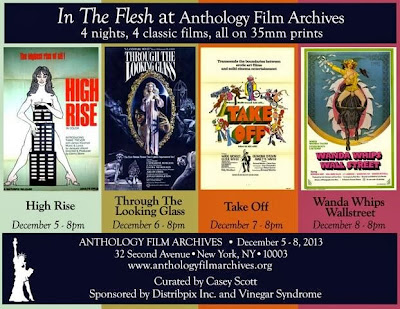
Today I am very happy to welcome another one of my favorite writers and film historians to Moon in the Gutter, Mr. Casey Scott.  Many of you will already be familiar with Casey due to his online writing (from DVD Drive-In to The Grrrl Can't Help It) to his work with DVD companies (ranging from Media Blasters to Vinegar Syndrome) to his academic work.  I know Casey as a friend as well and I consider him on of the most knowledgeable film historians on the planet whose work has provided a lot of inspiration.  Casey can now add film-curator to his long resume as he has a truly exciting and important program coming up at New York's Anthology Film Archives called In The Flesh.  To celebrate this event Casey kindly agreed to answer a few questions for us here at Moon in the Gutter.  I hope everyone enjoys the interview, will check out some of Casey's work and, if you are in the New York area, please attend In The Flesh December 5th through the 8th. 


Hey Casey, thanks so much for taking time out of your schedule to participate in this! First off, can you tell us a bit about your background?


      Thanks so much for approaching me for an interview! This is my first time being on the other side of an interview, and I’m honored it’s for a blog I really love. Well, I’ve been a film enthusiast since I was a kid and, like so many of us movie nuts, it stuck with me into adulthood. I dabbled with the idea of making movies for a time during middle and high school, when I shot a few amateur efforts with the family camcorder and took a TV production course, where I really loved the editing process. I still do. But I decided writing and research was what I most enjoyed about the film world, so I pursued my M.A. in cinema studies at NYU and just graduated in May, so watch out, world!
 
 
Was there a particular film, song or artist that initially sparked your interest in the arts as a child?


      I can honestly say I was always an artistic child, very into books and music, and film kind of transformed my life after I started digging into the classics from the studio era. All About Eve (1950), Gone with the Wind (1939), the usual big name titles. I’m still a hardcore classic Hollywood fanatic. Turner Classic Movies is my best friend, which may surprise some people who learn I’m obsessive about adult films. Barbara Stanwyck is my favorite actress, Cary Grant my favorite actor, I love Capra and Wellman and Ford, the list goes on and on…
 
 
A behind the scenes moment in 1941 with Barbara Stanwyck and Preston Sturges.
 
 
     The classic Hollywood films of the sound era are probably the most discussed in the world but lets switch gears and talk about sadly the least discussed, namely the adult and exploitation films of the seventies and eighties.   You are one of the leading film historians on this period in the world. How did you first get interested in the genre?


     Wow, well first of all, thank you for speaking so highly of me. It means a lot! I have had a photographic memory since an early age, and that helps with absorbing and processing so much information about the genre. I just love these movies and the people who made them! My interest in classic adult stemmed from my ongoing fascination with exploitation and sexploitation of the pre-hardcore era. I followed favorite filmmakers from the soft and horror world, like Gary Graver, Roberta Findlay, Doris Wishman, Roger Watkins, and Dave Friedman, into the hard world. Before that, though, the first three adult films I ever saw were Jim Clark’s The Good Girls of Godiva High (1979), Svetlana’s Bad Girls (1981), and Gerard Damiano’s Deep Throat (1972), which were secretly recorded on unmarked Beta tapes a family friend gave to me since he knew I collected them. Based on those three films (though I have soft spots for the first two) I really had no interest in looking further into the genre. It wasn’t until I saw Damiano’s Devil in Miss Jones (1973), Graver’s Coed Fever (1979), and Findlay’s Angel on Fire (1974) that I realized there was so much more to classic adult than what I had previously encountered. Then the floodgates opened and I’ve really never stopped since.
 
 
A shot of the lovely Annette Haven around the time she shot Coed Fever.


      This genre and period has typically been all but ignored in film studies and film history in general but this thankfully seems to be changing. Do you feel like the tide is finally beginning to change and that these films, and the artists who worked on film, might finally start to get some long overdue acknowledgement and recognition?
 
 
      I definitely think the tide is turning and reappraisals are in store for the genre and specific filmmakers in general. Radley Metzger has been receiving the lion’s share of attention, but other directors like Chuck Vincent, Rinse Dream, and performers-turned-directors like Candida Royalle and Annie Sprinkle have been discussed in serious academic pieces. That said I don’t know yet if we’ll see someone seriously tackle, say, Phil Prince or Alex de Renzy outside of the book I’m working on. I’d love to be wrong! Kevin Heffernan is the man for the job if anyone does a de Renzy project. The big problem with writing about any part of the “golden age” of erotica is it’s a grossly under-documented genre. Where major studio films and even independent commercial films have some kind of paper trail and press coverage, adult films generally don’t. Primary sources are the way to go, and they unfortunately are not always around to present the full picture to researchers, or aren’t willing to depending on how far they’ve moved on from the industry. Plus some writers don’t want to go that extra mile and talk to a large number of people before writing something. The great thing about adult film criticism and scholarship is that there are many different voices out there working with varied approaches to the genre, and frankly I don’t think we can ever have enough people doing that.
 
 
      There is of course a lot of mainstream opposition in the critical community to even discuss this genre. Have you felt any of that opposition to your own work?
 
 
      Oddly enough, I personally have never felt any overt opposition to my work writing about and documenting the genre except from other similar researchers. But yes, there continues to be general opposition from different corners of the academic and critical community. In the academic world the fundamental argument of whether these films should exist is still being fought decades after Linda Williams’ “Hard Core” established a definition of the genre and why its existence matter. Authors like David Flint and Jack Stevenson, Gloria Brame and Constance Penley, and many others continue the dialogue in important and interesting ways. In the critical world, people tend to equate all adult films with the contemporary state of the industry, which is so different from how it used to be. It’s easy to forget Variety, New York Times, Newsweek, etc. reviewed adult titles when it was considered hip to do so. Now that it’s becoming hip again to like the classic films, maybe they’ll start getting more mainstream respect. Until then, the cult surrounding them is very loyal and dedicated to their favorites, as the filmmakers and performers learn.
 
 
      Okay, lets talk up about In the Flesh, the exciting program you a curating at the Anthology Film Archives! Tell us about the program.
 
 
      I’m giddy with excitement about this series! It all started when Anthology Film Archives, which is in my opinion the edgiest repertory theater in New York City, scheduled two back-to-back sexploitation series this summer, a Russ Meyer series and a Something Weird Video series. I approached Andrew Lampert, one of the masterminds at Anthology, and suggested the natural progression in the history of sex in cinema was to do a hard series. To my surprise, he’d always wanted to do one! So I offered to program the series for them, working with Steve Morowitz at Distribpix and Joe Rubin at Vinegar Syndrome, since the three of us work really well together and share such passion for these movies and their history. The great thing is that this is not a one-time series. It will be a recurring quarterly series, so in every Anthology calendar, there will be an “In the Flesh” event. Working with Steve and Joe, the possibilities are endless. The March series is already scheduled, featuring four “adult noir” titles, and Joe and I are hashing out the summer series to be a departure from the previous series. Jed Rapfogel, the head programmer at Anthology, has been tremendous to collaborate with on shaping and scheduling the series, and their publicist Ava Tews has been a dream, too.

                                                      Why did you pick these particular films?


      When you’re brainstorming a series like this, of course you have titles that jump to the front of the queue, especially when working with Distribpix and their incredible catalog of films. Two important factors made the job easier: the films needed to be screened on 35mm and they needed to have guests present to provide historical context. So we eliminated any films that were only available on 16mm (sorry, Taking of Christina) and I knew films with cast and/or crew who would possibly attend a serious appreciative screening of their work. High Rise and Through the Looking Glass were always at the top of my list, and thank God 35mm prints exist! Take Off was a major title, and I knew I wanted a Larry Revene movie because his great book just came out, he is a gifted storyteller, and the world needs to be aware of what a treasure it has in Larry. I would have been happy to show his first directorial effort, Fascination (1979), if there was a print of it, but Wanda Whips Wall Street is better-known and just as good, if not better. Veronica Hart and Tish Ambrose always make everything better.


      The program looks wonderful and I so wish I could be there. Through the Looking Glass and Wanda Whips Wall Street are two particular favorites of mine. I hope it is very successful and the first of many. What do you hope viewers take away from the series, particularly those who are newcomers to the genre?
 
 
      I wish you could be there, too! The bummer about the series is that it’s not a traveling roadshow. I’d love to take these films to different venues around the country so that all their loving fans could see the classics on the big screen, as they were meant to be seen. Maybe if you or any of your readers suggest screenings at the local repertory or independent theater, we can head to you! I think it’s a strong possibility if the interest is there. The reason I wanted this series to happen was specifically so these films would find a wider audience. Anthology’s audiences tend to be inquisitive and adventurous, and have great taste, so I hope they discover some new favorites and might develop curiosity into what else the genre has to offer. If the audience comes away singing the High Rise theme song, with goose bumps from the ending of Through the Looking Glass, moved by Take Off, and cheering for Veronica Hart after Wanda, I will be a happy man.


      As a wrap-up I was hoping you might share some personal favorites with us. Could you perhaps name ten or so vintage adult films that you think are seriously in need of rediscovery. Also, are there any particular performers of filmmakers that you would particularly like to see rediscovered?
 
       Wow, that’s a great question, and so different from the expected “list your favorites of all time”! Um…I’m gonna cheat and give you a lucky thirteen.
High Rise (1972) – We’re showing it in the Anthology series and it’s the least-known of the four, but should be wider regarded as the best early adult comedy. The soundtrack is Hollywood-caliber.
Resurrection of Eve (1973) – It’s way better than the Mitchell Brothers’ better-known Behind the Green Door and is also Marilyn Chambers’ best film.
The Seduction of Lyn Carter (1974) – Anthony Spinelli’s most neglected masterpiece, where Andrea True blows my mind as a housewife in an abusive affair with Jamie Gillis that she secretly enjoys.
Easy Alice (1976) – This is a marvelous meta film about the off-screen adventures of a San Francisco adult star, Joey Silvera, who also reportedly directed the film.
Punk Rock (1977) – Carter Stevens is all around underrated, and I think this is his best film tied with Pleasure Palace (1979). See both, they’re quintessential “adult noir”.
Skin-Flicks (1978) – Damiano’s most underrated film, wall-to-wall great performances, with special note made for Sharon Mitchell as an adult star eager for true love.
Tropic of Desire (1979) – Bob Chinn weaves a fascinating story of a WWII-era brothel in Hawaii. A personal favorite of Bob’s and I concur.
Randy (1980) – The one adult film from Phillip Schuman, this sex comedy following a clinical study of ‘anti-orgasmic’ women seeking a solution to their problem is one of the best films you’ve never seen. The theme song is a catchy gem.
The Seductress (1981) – Another of Bob Chinn’s most underrated, out of a filmography that needs more attention in general.
Mascara (1982) – Lisa de Leeuw and Lee Carroll are superb as, respectively, a sexually frustrated working woman and the prostitute she enlists to help her broaden her horizons.
Nasty Girls (1983) – Ron Sullivan’s most unsung “day in the life” film, following a group of people over one night at a bar as their lives intertwine.
American Babylon (1985) – The Roger Watkins film too few people have seen.
Getting Personal (1985) – Ron Sullivan directing Herschel Savage and Colleen Brennan as mismatched con artists. Funny, touching, beautifully acted. One of the last great FILMS in the genre before video took over.


      Performers in need of rediscovery: I mentioned Tish Ambrose earlier and she was a tremendous actress that needs a stronger following. She is easily one of my picks for best adult film actress of all time. So is Sharon Mitchell, who I think many take for granted given her years in the business. She hits all the right notes in her acting performances; so does Lisa de Leeuw. Merle Michaels is a favorite cult icon with superstar quality, and I’d say the same about Sue Nero and Desiree West, Suzanne McBain and Nicole Noir, Misty Regan and Jeanne Silver, the late Arcadia Lake and Kandi Barbour.

The much missed Kandi Barbour, who we lost in 2012.


      I’ll stop there! As a gay man, there are underrated studs like Jeffrey Hurst, Ron Hudd, Mike Ranger, and John Seeman I would follow anywhere. Their wives are very lucky!

      Directors in need of rediscovery: Alan Colberg was consistently great, as was Jeffrey Fairbanks, and both only made a handful of films so their names are not widely known as they should be. Two directors who are big names yet still don’t get the full credit they deserve are Bob Chinn and Ron Sullivan (Henri Pachard). But the most underrated are the French classic directors, like Claude Mulot, Gerard Kikoine, Francis Leroi, Didier Philippe-Gerard, and Claude Bernard-Aubert. Their films aren’t widely available here but they are almost always a guaranteed bargain.


Awesome Casey!  Thanks so much for participating in this and I wish you all the best of luck with In the Flesh and all of your upcoming work.  I look forward to doing another one of these down the road to discuss more of your upcoming projects. 


Help RESTORE DETOUR at Kickstarter

$
0
0
Please take a moment and help out this very valuable project at Kickstarter by pledging and sharing this link.  Thanks!

Sanskrit Read to a Pony: A World Without Lou Reed

$
0
0
A Sunday morning ago I awoke to my usual routine.  The alarm went off and I quickly silenced it as not to disturb my wife Kelley, who usually sleeps a bit later than I do.  Our dogs, Molly and Maizie, excitedly scurried around my feet as I put on the pajamas that always inevitably get kicked off during the night.  After a quick stop in the restroom, the three of us head downstairs where I let them take care of their business outside and then we all rush to my cat Mazzy's room, where he is anxiously awaiting, as he knows our morning arrival signals his breakfast time.  I flip the coffee on, feed the animals and then pick out some music.  My selection this past Sunday was my well-worn, but much-loved, autographed copy of Lou Reed's LP The Blue Mask, the very same copy my father had brought home for me more than twenty years ago from a trip to New York.  With the first cup of coffee poured I flipped my turntable on, dropped the switch, and waited for the opening moments of "My House" to fill the room but nothing happened.  I tried again but the needle strangely wouldn't drop and just remained in its resting position.  Frustrated, I manually picked the needle up and dropped it on the still shiny black vinyl but the sound coming out of the speaker was foreign to me...draggy...not right.  I verified the speed was at 33 1/3 and tried again but got the same result.  After a couple more attempts I gave up, figuring the belt needed replacing, even though when I tried again later in the day it played perfectly. 


A life is filled with Sunday mornings.  I have been thinking of a number of them these past few torturous days like the Sunday in the fall of 1987 when I found a copy of Lou Reed's Growing Up in Public in my father's record collection.  I was fifteen and within the span of just under forty minutes my life was forever changed.  It's funny, as many truly defining moments can happen without a person realizing it but I knew instantaneously.  I had found the voice I had been looking for...the meaning.  I had found the voice that I knew would be there from that day on and I knew I would never really be alone again. 

Kelley came down about an hour after I got up this most recent Sunday morning.  We quickly got ready to go out to get some final supplies we needed for the Halloween party we were having that evening.  I was feeling pretty rough due to an emergency root canal I had had the day before and I took some prescribed pain medicine to help forgot how uncomfortable I was.  We got back in the early part of the afternoon from the store and, as we were unpacking the groceries, I noticed I had a message on my phone.  Opening the notifications tab I saw it was a Facebook message from my friend John Levy.  Without opening the full message all I could see was "Hey Jeremy, I'm sorry to report that Lou Reed has..."  I didn't have to open the message to see the rest.  Stunned and feeling sick I made my way over to the steps next to our door and fell against them.  The tears didn't come immediately although I would have preferred them to the terrible feeling that surged through my entire body.  Our little dog Maizie sensed that something was wrong and came up to check on me.  I grasped on to her and whispered, "my voice is gone" and then the tears came...


The first time I ever got my heart broken came on a Sunday morning as well.  Getting your heart broke by an unrequited love is a necessary part of  growing up.  The first time I ever had my heart truly fractured came around the winter of 1992 when I was rejected by a very special young lady who had been my best friend for the better part of a couple of years at that point.  There is something really dramatic about being in love in your late teens and I was, of course, convinced the world would end.  After the Saturday night rejection I had made my way to my friend Trace's house as the sun rose on an extremely cold and snowy Evansville, Indiana morning.  The snow was beautiful, the roads were treacherous and a cassette dub of The Blue Mask, with Coney Island Baby on the flipside, kept me warm physically and spiritually that morning.  Before we lost touch for a painful spell in the mid nineties (due to a fall off the planet earth that I took) Lou Reed was able to offer some solace to her as well, on another Sunday morning, when I sent her the lyrics to "Magic and Loss" to help her deal with the passing of one of her grandparents.  On Sunday she was one of the first people to send me some much needed words of sorrow with, "I thought of you immediately. I can't believe he's gone."  I got similar messages from many friends throughout the week, all of which were greatly appreciated.

I did my best to put on my own personal blue mask during our Halloween party, as the last thing I wanted to do was ruin it for Kelley.  I had originally planned to dress as the mom from Psycho but changed my mind and attempted to morph myself into Candy Darling as my own internal tribute to Lou and a time that now seemed more far away than ever.  I laughed, I socialized and I watched Kelley's friends make their way in all through the night...all of them much prettier and younger than I.  I wondered what they thought of me, as the seven hour Halloween mix I had spent the week before creating played in the background.  I couldn't hear it though, I could just hear Lou's voice in the distance but instead of having a Peter Laughner type breakdown I maintained my cool and somehow even managed to enjoy myself even though I dreaded waking the next morning.


Years before I stopped speaking to nearly everyone I had loved, and that had loved me, I would spend many a Sunday morning with friends and lovers.  Late Saturday nights that bled into those mornings have been filing in and out of my brain all week.  An impossibly late night with my friend Ryan listening to different versions of "Heroin" in his basement room with his father occasionally interrupting wanting to know what we were doing.  A Sunday morning in 1994 spent with my most corrosive and passionate partner Shayna making love and listening to the Live in Berlin bootleg I had picked up the day before at a local Bloomington, Indiana record shop walking distance from her place.  Introducing Take No Prisoners to my friend Dave, who just recently recalled a bit of his favorite between song banter to me again all these years later, and seeing Lou for the first time live with my oldest friend Kimbre.  Memory after memory of hundreds of Sunday mornings have been coming back to me starring so many people from my past, a number of whom got in touch with me this week via phone-calls, texts and emails making sure I was okay. 

It was indeed all those incredibly kind messages that I have gotten throughout the week, from people (some of whom I have never even met) who recognized that this wasn't just another celebrity passing for me.  Lou Reed was family, the brother I never had, the best friend who I didn't let go of, the voice that helped me through every crisis (small and major) I have faced in my adult life.  For the past quarter of a century the knowledge that there would be more lyrics and music from him to help get me through the most difficult nights, and darkest days, has always been there.  Now that knowledge is gone and I don't know what to do.  What am I going to do without Lou Reed?  That thought has plagued and troubled me all week.  One friend noted that the music and words will always be there to offer their help and support but the idea that there won't be more coming, that the voice I have depended on for so long has been silenced, is absolutely devastating to me.  I still haven't been able to process the news of Lou Reed's passing.  I recall the story that Jerry Schilling told about Brian Wilson's reaction to Elvis Presley dying.  "What do we do now? I don't know what to do."  I know I am not the only one feeling that way right now. 

The world has felt and looked strange since Sunday October 27th.  Feelings of anger and despair have mixed with a strong sense of gratitude and love the past few days.  I feel different, dazed and not sure what my next move should be.  I am grateful for Kelley, and our little furry family, and I am grateful for the memories...grateful for all those Sundays since that fateful day more than 25 years ago when I first discovered the artist who would have the greatest impact of any on my life.  Lou Reed blew open my mind and introduced me to artistic, cultural and spiritual worlds I had never known of before.  Attempting to imagine what my life would have been like if I hadn't discovered and fell completely in love with his work is not only impossible but also unthinkable.  The Jeremy Richey I am today simply wouldn't exist...I wouldn't be married to Kelley, there would be no Moon in the Gutter, I wouldn't have the memories and friends that I do...none of it would be the same.  More than likely I would have become that middle class conforming douchebag I have always hated and, while I ultimately might not be worth a damn, I can at least look myself in the mirror each day with the knowledge that I am still, deep-down, that transformed 15 year old kid in Indiana discovering and embracing a world I found in the dusty grooves of a cut-out record my father had buried in his collection. 


I wish I could write a proper tribute to Lou Reed but I am just not capable right now.  I loved this man so much and his work meant everything to me.  I honestly thought he would never die...at least not in my lifetime.  If there is an "over there" then I hope Lou has seen all of the incredible tributes that have been pouring out of people he touched, all over the world, and I hope that he can feel all of the love.  We have lost the most important figure in popular American music since Elvis Presley and one of our finest poets.  I, and many other folks around the world, have lost a friend, mentor and spiritual guide.  Lou Reed taught us to see the light and we can all take some comfort in the thought that while the source is gone the reflection can still be found in the people touched by him. 
 
-Jeremy Richey, 2013-


Dedicated to Laurie Anderson and my Father.

Two New Jean Rollin Related Releases